Important! Self-medicating with prescription or over-the-counter medications or other substances can be dangerous.
What age does male libido decrease?
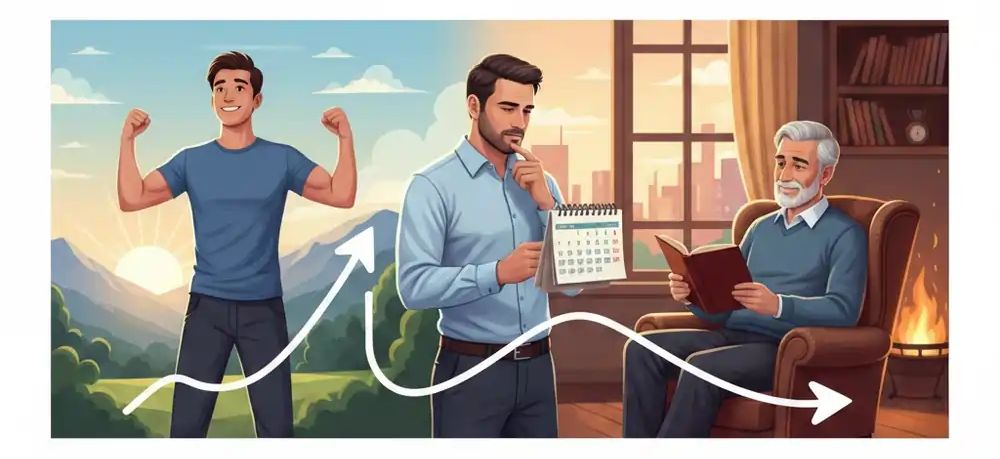
There isn’t one universal birthday when it drops. On average, many men see gradual changes starting in midlife, but desire often stays stable into the 30s and can peak around the late 30s to early 40s, then declines slowly later.
If you’re browsing options like herbal supplements for male libido, treat them as optional and secondary. Prioritize basics like sleep, stress, relationship context, and medical causes first. Supplements can interact with medications and vary in quality, and they should not be framed as cures.
This guide breaks down age patterns from large studies, separates libido from erectile function, and gives a practical “what to do next” checklist.
What does “male libido” mean in research terms?
Libido usually means sexual desire: interest, motivation, or sexual thoughts. It is related to hormones (especially testosterone), but it also depends on mental health, sleep, stress, relationship satisfaction, chronic disease, and medications.
Important: libido is not the same as erections. A man can have normal desire and still have erectile dysfunction (ED), or have low desire with normal erections.
At what age does male libido typically start to decrease?
What the newest large population data suggests
A 2026 paper in Scientific Reports using a large Estonian biobank sample (67,000+ adults) found that men’s self-reported sexual desire tends to rise through early adulthood, peaks around the late 30s/early 40s, and then declines gradually, with a notable drop compared with younger levels appearing more clearly after ~60 on average.
What older longitudinal and cohort research shows
Longitudinal work on middle-aged and older men shows measurable age-related changes in sexual function markers over time (frequency of sexual activity, erections per month), with larger declines from the 40s into the 60s.
This does not prove “libido collapses,” but it supports the idea that midlife-to-later-life is where declines become more common.
Why do people think libido drops earlier?
Because testosterone starts declining earlier than many men notice changes in desire.
Multiple clinical sources state that testosterone typically declines about ~1% per year starting around age 30–40 (the exact slope varies by person and by what you measure).
But desire is not driven by testosterone alone. The 2026 Scientific Reports findings are a good illustration: average desire can keep rising into midlife even while testosterone trends down.
A practical age-by-age picture (what often changes)
Table 1 — Typical patterns by decade (averages, not rules)
| Age range | Libido (desire) | Hormones | Sexual function signals that often change |
|---|---|---|---|
| 20s | Often high, variable | Testosterone high on average | Stress, anxiety, porn use patterns, and relationship novelty can dominate |
| 30s | Often stable; may increase for some | Testosterone may begin slow decline | Sleep debt, parenting, workload start to matter more |
| Late 30s–early 40s | Peak in some population data | Ongoing gradual decline | Desire can stay high even with mild hormone changes |
| 50s | More variability | Higher risk of low T symptoms in some | Chronic disease and medication effects show up more often |
| 60s+ | Average desire declines more clearly | Decline continues | ED prevalence and “bother” rates rise with age |
Libido vs erectile function: the “common confusion”
A lot of men interpret erection changes as “low libido.” ED becomes more common with age, even when desire is still present.
Stat block: Massachusetts Male Aging Study (MMAS)
In the MMAS (men aged 40–70), the combined prevalence of some level of ED (minimal/moderate/complete) was 52%, and complete impotence rose from 5% at age 40 to 15% at age 70.
That’s one reason the question “What age does male libido decrease?” gets messy: for many men, performance changes lead the conversation, not desire.
What causes libido to decrease, besides age?
Age is a backdrop. The drivers are often modifiable.
1) Sleep and circadian disruption
Short sleep and sleep disorders (including sleep apnea) can reduce energy, mood, and sexual interest. A lot of “libido decline” is actually fatigue plus stress.
2) Depression, anxiety, and chronic stress
Mental health strongly affects desire. Also, certain antidepressants (especially SSRIs) can reduce libido. (If this applies, a clinician can help with options—do not stop meds abruptly.)
3) Metabolic health and cardiovascular risk
Obesity, diabetes, hypertension, and low physical activity correlate with both ED and lower sexual satisfaction. ED is also considered a potential marker of vascular health in many clinical discussions.
4) Hormonal factors
Testosterone matters most when it is clinically low and paired with symptoms. Guidelines emphasize proper evaluation (symptoms + repeated morning labs).
5) Relationship context
Relationship satisfaction and context predict desire in big datasets, including the 2026 Scientific Reports analysis.
How do you know if your libido drop is “normal aging” or a health issue?
Use two filters: severity and change over time.
Signs it may be a normal shift
- Desire is lower than your 20s but still present.
- You can still feel interest with the right context.
- The change is gradual and not distressing.
Signs you should consider a medical check
- Sudden or major drop lasting 3+ months
- New ED, especially with cardiovascular risk factors
- Symptoms of testosterone deficiency plus low libido (fatigue, low morning erections, low mood) — discuss with a clinician and follow guideline-based testing
- Medication changes followed by libido change
- Depression, anxiety, or persistent sleep problems
What helps most
This is not a “quick fix” topic. The strongest, most repeatable wins are boring but effective.
Checklist: a practical first month plan
- Track sleep for 7 days (bedtime, wake time, awakenings).
- Reduce alcohol binges; alcohol can suppress sexual function.
- Add 150 minutes/week of moderate activity (walk, bike, swim).
- Review medications with a clinician if libido changed after a new prescription.
- If ED is part of the issue, treat it as a medical topic, not a willpower issue.
- If you suspect low testosterone, follow guideline-based testing (morning labs, repeat confirmation).
- Address relationship stress directly (communication, counseling if needed).
Where supplements fit (and how to stay compliant and safe)
People search for libido supplements constantly. The problem is that evidence quality varies, and products vary.
Safe framing:
- Supplements may support wellness factors for some people.
- They do not reliably “fix” libido for everyone.
- They can interact with medications and health conditions.
- If you have symptoms, prioritize assessment first (sleep, mental health, hormones, cardiovascular risk).
If you choose to use a product, look for third-party quality testing and discuss it with a clinician—especially if you take anticoagulants, blood pressure meds, antidepressants, or have heart conditions.
Stat blocks
- Testosterone generally declines ~1% per year starting around age 30–40 (average estimate; individual variation is large).
- In MMAS, ED of any degree was reported at 52% among men 40–70; complete impotence increased from 5%(age 40) to 15% (age 70).
- A large 2026 population analysis found men’s sexual desire tends to peak in late 30s/early 40s and declines more clearly later, with wide individual variation.
FAQ
1) What age does male libido decrease most often?
On average, many men notice gradual changes after midlife. Large data suggests desire often peaks around the late 30s/early 40s and declines more clearly later, especially after ~60.
2) Does testosterone drop automatically mean libido drops?
Not always. Testosterone declines gradually from about age 30–40, but desire is also shaped by stress, sleep, health, and relationship context.
3) Why do I feel less desire in my 30s?
Common causes include sleep loss, stress, depression/anxiety, relationship strain, alcohol, and medication effects. Age alone is rarely the full explanation.
4) Can erectile dysfunction be mistaken for low libido?
Yes. ED becomes more common with age, and many men interpret performance changes as reduced desire.
5) When should low libido be evaluated by a clinician?
If the drop is sudden, lasts 3+ months, causes distress, or comes with ED, low mood, sleep problems, or other new symptoms—get evaluated.
6) Should I test testosterone if my libido is low?
Consider it if you have persistent symptoms. Guidelines recommend morning testing and confirmation before diagnosing deficiency.
Glossary
- Libido / sexual desire: Interest or motivation for sexual activity.
- Testosterone: Primary androgen hormone linked to sexual function and other systems.
- SHBG (sex hormone–binding globulin): Protein that affects how much testosterone is bioavailable.
- Late-onset hypogonadism: Clinically low testosterone with symptoms developing later in life.
- Erectile dysfunction (ED): Persistent difficulty achieving/maintaining erection adequate for sex.
- SSRIs: Antidepressants that can reduce libido in some people.
- Metabolic syndrome: Cluster of risk factors (waist, BP, glucose, lipids) linked with vascular and hormonal health.
- Circadian rhythm: Body clock affecting sleep and hormone timing; impacts energy and mood.
What age does male libido decrease? | Conclusion
There’s no single age when male libido decreases for everyone. Population data suggests desire often peaks around the late 30s/early 40s and declines gradually later, while health, sleep, stress, and relationship factors usually explain more than age alone.
Sources
- Aavik T. et al., Scientific Reports (2026). “Associations of Sexual Desire with Demographic and Relationship Variables.” https://www.nature.com/articles/s41598-025-23483-0
- PubMed record for Aavik T. et al. (2026). https://pubmed.ncbi.nlm.nih.gov/41491164/
- Feldman HA. et al., J Urol (1994). MMAS ED prevalence findings. https://pubmed.ncbi.nlm.nih.gov/8254833/
- Johns Hopkins Medicine (accessed 2026). Erectile Dysfunction overview and MMAS summary. https://www.hopkinsmedicine.org/health/conditions-and-diseases/erectile-dysfunction
- Mayo Clinic (accessed 2026). Testosterone declines ~1% per year after 30–40. https://www.mayoclinic.org/healthy-lifestyle/sexual-health/in-depth/testosterone-therapy/art-20045728
- NHS (updated page; accessed 2026). “Male menopause” and testosterone decline notes. https://www.nhs.uk/conditions/male-menopause/
- American Urological Association (AUA) Testosterone Deficiency Guideline (2018; accessed 2026). https://www.auanet.org/guidelines-and-quality/guidelines/testosterone-deficiency-guideline
- Araujo AB. et al., J Am Geriatr Soc (2004). Longitudinal changes in male sexual function. https://pubmed.ncbi.nlm.nih.gov/15341552/
- Chung E. et al., review on aging male sexuality (2019). https://pmc.ncbi.nlm.nih.gov/articles/PMC6835548/